Structure is what makes wellbeing work hold.
Wellbeing work carries real risk when roles and scope are unclear. STEP replaces informal goodwill with shared structure, so the work does not depend on any one person staying.
What STEP actually builds.
Six pieces that let a school add capacity without adding risk.
Structured placement roles
Placement students across disciplines know where they fit and how they add value.
Scope and permissioning
Every task permissioned against readiness and school value. If you are unsure, it is not a yes.
A shared supervision model
Predictable, distributed and sustainable. Set up through the Supervising Well workshop.
Escalation pathways
Risk is held by appropriate paid staff and leaders, never by placement students.
Operating rhythms
Attached to the calendar that already exists, so the model runs without heroics.
Governance and drift review
An annual check that catches drift before it becomes risk.
Where a placement student fits, and where they never will.
Support that reaches every student, whether or not anything is wrong. Programs, structures and a culture that build wellbeing before it becomes a problem.
Placement students work here · scoped and supervisedSupport for smaller groups or individual students showing early signs of need, delivered before difficulties escalate.
Placement students work here · scoped and supervisedSustained, specialist support for students with significant or complex need, including risk and crisis response.
Selected tasks only · risk and crisis work stays with paid staffA team at its ceiling is one where Tier 3 has absorbed the week. A well-hosted placement student adds capacity not by taking on risk, but by making Tier 1 and Tier 2 run to a rhythm again.
Tiered support is not STEP terminology. It is the organising logic behind the Schools Mental Health Fund and Menu, the Australian Student Wellbeing Framework and Be You.
Step one
The Wellbeing Capacity Review.
Before STEP recommends anything, it measures. Three to six weeks, five sessions, one written report. One flat scope, whatever your size.
One
Choose how it runs
Onsite, hybrid or fully online. The diagnostic is identical in every mode, and so is the investment. Distant schools default to fully online at no travel charge, because a country school should not pay more for the same review.
Two
Five sessions
A structured five-session diagnostic, scheduled around your calendar. Around three to four hours of school-facing time in total.
Three
Four things you keep
A written diagnostic report triangulated across all three groups. A ten-domain scorecard. A prioritised roadmap, sequenced and owned. And a pathway recommendation, naming which of four next steps the evidence supports: internal improvement only, ongoing practice support, the Supervising Well workshop, or an Implementation Partnership.
The five sessions.
Findings are triangulated across three separate groups, not gathered from one conversation with the principal.
walkthrough 30–45 min
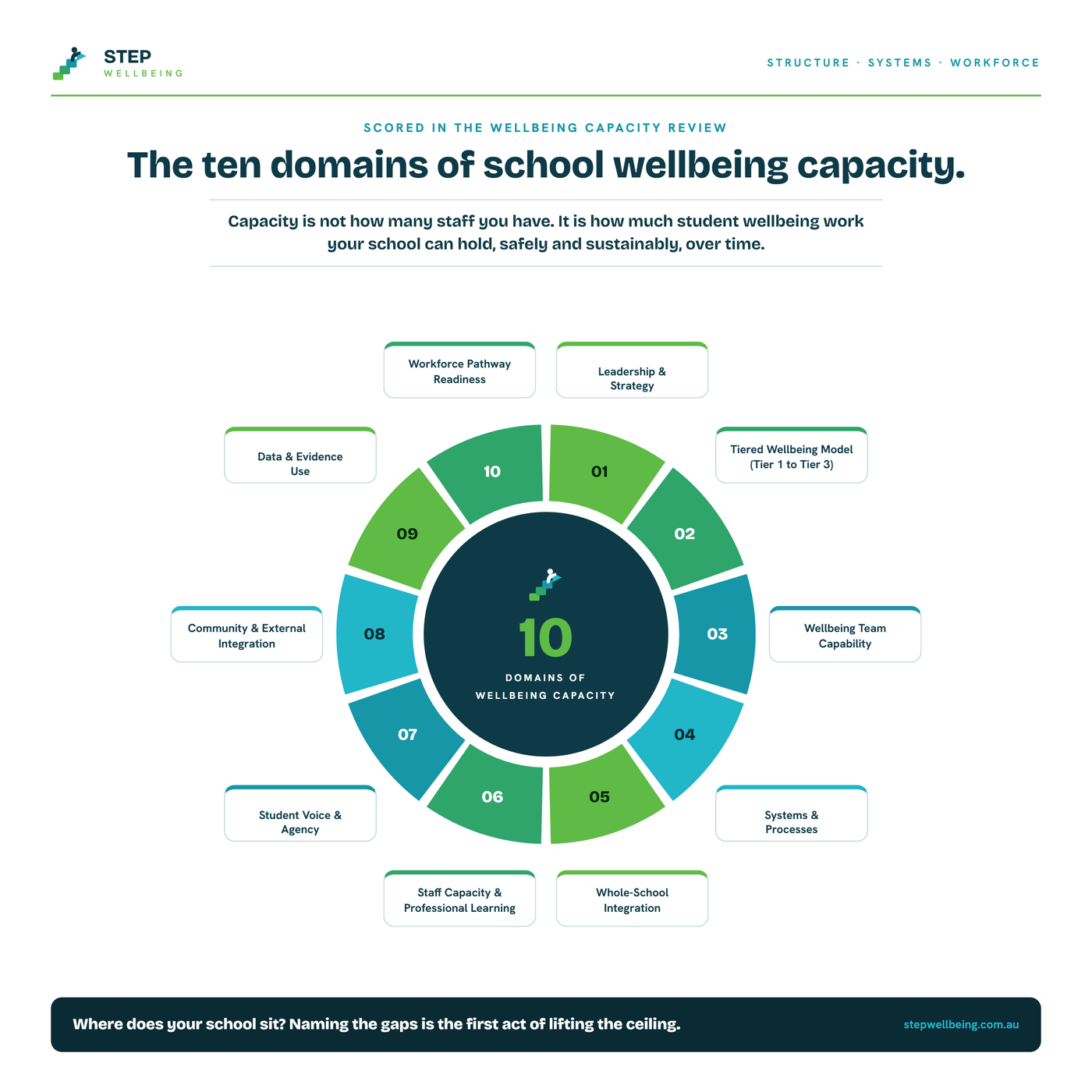
Ten domains, two questions.
Every domain is scored out of five and RAG rated, with the evidence behind it, the key insight and the priority action. All ten answer what should we fix, and in what order. That becomes your roadmap.
Six of them do a second job. Together they form a Readiness Index that sets how much support a build would actually need, which is the honest way to size a partnership rather than asking what you would like to buy.
The Review carries in full. Take it on its own and act internally, or carry it across as stage one of a partnership commenced within twelve months. You never pay twice for the same thinking, and choosing not to build is a genuine outcome rather than a failed sale.
Step two
The Implementation Partnership.
A guided twelve-month build of your workforce capacity model. Twelve months rather than ninety days, because a short cliff does not produce a model that holds.
Level one
Equip
For schools with strong internal leadership and real supervision capacity. STEP provides the architecture, explains the resources properly, and checks it is holding. Then you run it.
Level two
Guide
For capable schools that want STEP alongside them through the build, with a regular operating rhythm through the first placement cycle.
Level three
Embed
For whole-school rollouts, multiple supervisors, or schools where complexity means the model needs holding. STEP sits inside the leadership rhythm.
Every task is permissioned before anyone does it.
The Scope Matrix is the safety spine of the model. It runs from Tier 0 systems work up to Tier 3 individual support, and it assigns every task domain a permission level: Contribute, Supported, Observe, or Excluded. Some domains carry two, because the permission depends on the task.
Crisis response, risk assessment, safety planning, mandatory reporting decisions, clinical assessment and return-to-class decisions sit permanently at Excluded. Those are paid, qualified staff, always.
“If you’re unsure, it isn’t C.” When in doubt, drop a level: C to S, or S to O. Escalation is the safe default.
Contribute · Supported · Observe · Excluded, paid staff only
The same model is built at every level. What changes is how hands-on STEP is, never what gets built. Your level is set by your readiness profile, not by preference or budget.
This is a high-touch year.
Twelve structured sessions across twelve months. At the middle level that is around nine points of contact, three of them full onsite days, clustered deliberately because the days that change practice need everyone in the room.
Kickoff and readiness workshop. Sponsor and scope agreed, STEP Lead and Task Supervisors named, supervision time mapped, capacity band set.
Selection and screening setup, the full 2.5-hour Supervising Well workshop, staff communication, and the onboarding readiness review.
End of placement, the next-intake call, the Annual Governance and Drift Review, and transition into Operating agreed rather than sold.
An activation check in the first fortnight, an operating rhythm of around five touchpoints every five to six weeks, and a midpoint review before the university’s own.
Included at every level
- The full five-module pathway
- The Supervising Well workshop, in full, at every level — it is never removed
- Supervised placement workforce design
- Supervision and governance setup: scope, escalation, role cards
- University interface and placement narrative
- Forty-five artefacts and templates across five modules, released in sequence: Readiness & Leadership Alignment, Workforce Sourcing, Screening & Selection, Onboarding & Induction, and Operating & Supervision
- Staff buy-in and operating rhythm setup
A named STEP Lead, protected
Key person change is the most common way these models die. If your STEP Lead moves on, STEP re-anchors the model with your incoming lead at no cost.
Then year two: Operating
An annual layer that keeps the model current, governed and safe: resource updates, cascade rights so your own lead can re-run the workshop, STEP Partner School status, network participation, and the Annual Governance and Drift Review. It is a renewal, not an entry.
What you actually get.
The Implementation Playbook is the operating manual at the heart of the partnership. STEP runs it with you in year one, and it stays with your school to run yourselves afterwards.
Five modules, each with its own artefact set, released as you reach them. Not a folder dumped on day one.
Runs across all five modules
The Implementation Tracker
Every phase, every task, one view. Each task carries an owner, a due date, a definition of done and a status you cycle with a click, linked to the artefact that does the work.
A working tool rather than a document, and what stops a twelve-month build becoming a folder nobody opens in Term 3.
The five modules.
Module 1
Start STEP
Readiness, roles and set-up
Confirm readiness, assign accountability and set a safe structure before sourcing anyone. Ownership nominated, supervision capacity confirmed, capacity band selected.
Artefacts: a readiness and capacity diagnostic, role cards in desk and print formats, and a 30-day start plan.
Module 2
Source placement students
University outreach, offer and timing
Reduce the university, admin and timing bottlenecks that usually stop schools accessing suitable students at all.
Artefacts: a searchable contacts tool, outreach and follow-up sequences, an offer narrative, and two placement flyer formats.
Module 3
Select and set up
Screening, fit, confirmation and safety
Selection becomes defensible instead of a gut call. Any single red flag triggers a hold, whatever the total score.
Artefacts: a structured interview guide, a scenario prompt that tests escalation judgement, a scored rubric, and the confirmation and decline correspondence.
Observable facts only · a staff member reviews the patterns
Module 4
Onboard
School literacy, boundaries and quick wins
Contribute from Week 1 through observation, quick wins and debrief-supported tasks, without overreach.
Artefacts: induction run sheets, a pocket boundary card, shadowing and quick-win menus, conversation scripts, and observation tools that feed your existing inclusion evidence.
Module 5
Run and review
Operating rhythm, supervision and sustainability
Scope, supervision and task value reviewed regularly, so the model stays safe and useful rather than drifting.
Artefacts: a weekly operating checklist, meeting agendas, a triage tool, supervision logs, and midpoint, end-of-placement and annual review preparation.
Across every module
The core operating system
Seven pieces are not tied to one module. They run the whole thing, and they stay with your school under an Operating Partnership: the Playbook itself, the Tracker, the Scope Matrix, the weekly timetable builder, the Supervision Guide, the supervisor desk card, and a plain-English comparison of the placement disciplines.
Four are working tools rather than documents. You fill them in, and they hold your school’s actual data.
STEP is not a placement folder or a set of templates. Every school with these artefacts also has the supervision architecture, the university relationship and the operating rhythm built around them. That is what the partnership is. The pack is what makes it survive a staffing change.
Ongoing support · no prerequisites, no set order
Practice Partnership
A thinking partner for your wellbeing team.
Running a school wellbeing team is relentless. This gives your leaders someone in their corner to think clearly, steady the systems, and build the confidence to reimagine how the wellbeing workforce works. It runs alongside anything else, or entirely on its own.
One
A steady rhythm
Regular sessions with your wellbeing lead, team and leadership. Online or onsite.
Two
Name the real problem
Work happens at the level of systems and practice, never individual student cases.
Three
Build capacity to lead
Leaders grow the confidence to think creatively about new workforce models, with a clear next step each session.
Three ways in.
Same idea, scaled to your school.
Practice Advisory Support
For a single wellbeing leader or a small team. A termly check-in rhythm, plus a couple of joint sessions with leadership.
Team & Leadership Partnership
A working rhythm across individual staff, the whole wellbeing team and leadership alignment, where wellbeing leadership is shared.
Strategic Practice Partnership
Sustained executive engagement for larger or more complex schools. Onsite planning and review days, and regular executive check-ins.
It is for you if
- Your wellbeing team is stretched and reactive
- Roles, workflow or priorities feel unclear
- Leaders want a sounding board who understands schools
- You want to rethink how your wellbeing workforce is built
- You want prevention, not just fire-fighting
What it is not
- Therapy or counselling
- Clinical supervision
- Student case management or crisis response
- A replacement for your duty of care
The honest promise. Your team leaves each session clearer about what matters and what to do next. That is it. That is the value.
The honest bits.
What we ask of your school
- Nominate a named STEP Lead, school contact and Task Supervisors
- Protect the required supervision time and practice touchpoints
- Honour scope, boundary and escalation settings
- Keep the focus on sustainable Tier 1 and Tier 2 capacity, not Tier 3 substitution
- Review participation when staffing, capacity, university or funding conditions change
What STEP does not do
- Therapy, counselling, clinical supervision, student case management or crisis response
- Individual student advice, risk assessment or decisions
- Staffing or recruitment brokerage
- Legal, industrial, medical or clinical governance advice
- Guaranteed university supply or student availability
STEP reduces risk; it is not legal, clinical or compliance cover, and does not replace your school’s child-safety or mandatory-reporting obligations. See the Child Safety Policy.
See where your school sits before you decide anything.
Two minutes, ten domains, no email needed to see your result.